
Chiropractic First
Complete care for optimum health.
About Us Client Info Coaching Your Wellness News Contact Us
For Clients For Clients
Chiropractors locate and treat vertebral subluxations.


Auto accidents often lead to more headaches than you can think of, including car repairs, insurance concerns, loss of work time and income. This can lead to more stress than the injury itself and can affect your overall wellness.


After an Auto Accident: What You Should Know

Attorney, Timothy A. Gill, of San Jose , graduated from the Santa Clara University School of Law and has practiced personal injury law for the last nineteen years.  His firm has the experience of completing over eighty jury trials.  If you have any questions, please contact him at (408) 938-3467 or visit his website. In the mean time, below you'll find vital information and advice that will help you with the details of an auto accident.

What You Should Know About Insurance Companies
Everyone knows accidents will happen.  To soften the blow we buy insurance, trusting insurance company promises that after an accident they will help pay our damages. But do insurance companies keep their promise?  What really happens after an accident, and what accident victims can do about it, is something everyone should know. After a car or other accident, the victim usually makes a claim to an insurance company.  Their goal is to get paid for medical bills, property damage and other losses.  But the insurance company doesn't make money by paying claims.  They make money by not paying claims.  So insurers often use tactics to avoid or delay paying claims.  Here are some they use, and how to avoid being a victim:

  • They gain the public's and your confidence by using friendly slogans like “you're in good hands” or “Like a good neighbor.” 
  • They act as if they are working for you.  Don't let these slogans fool you.  Insurance adjusters, no matter what they say, work for the insurance company, not you.
  • Adjusters deny many claims they know are covered.  They do this because they hope that by denying a claim, they won't hear any more about it, even if the denial was wrong.  This makes more money for the insurance company.  Protect yourself after an accident by asking a lawyer about any claim an insurance company denies.
  • Insurers take a narrow view of what's covered.  This is just another way to deny claims.  They do this despite court decisions telling them to take a broad view of coverage.   A lawyer can tell you truthfully if a claim is covered.
  • Adjusters try to persuade accident victims not to use a lawyer.  They do this because they know that accident victims who use lawyers are much more likely to get larger settlements. 
  • Insurers delay paying claims.  They hope this delay makes you give up your claim, or that by the time you decide to file a lawsuit, the deadline for filing has passed.
  • Insurers conceal information that may help you.  By having a lawyer's help, you're more likely to get a full investigation, so any information that benefits you is revealed.
  • Insurers say your claim is worth less than they know it is.  Again, get a lawyer's help.  Your lawyer can tell you everything you recover damages for, and protect you against adjusters who try to lowball you in the claim settlement process.

These are some tactics adjusters use to lower accident payoffs and make more money for the insurance company.  By knowing about them, you can identify when they happen to you.  You can then take action to avoid being a victim twice-once at the accident and again at the hands of an insurance company.

How to Finance Your Treatment After An Accident and Be Compensated for Your Damages
The typical accident victim, fortunately, has not sustained any fractures of the bones.  Instead, the injuries suffered are multiple strains and sprains of the ligaments, muscles, and other soft tissues of the spine.  These soft tissue injuries are difficult to diagnose and can be quite painful, severe, and long lasting.  If not treated early and by the proper methods, they can lead to chronic and disabling complications.

Treatment of Choice
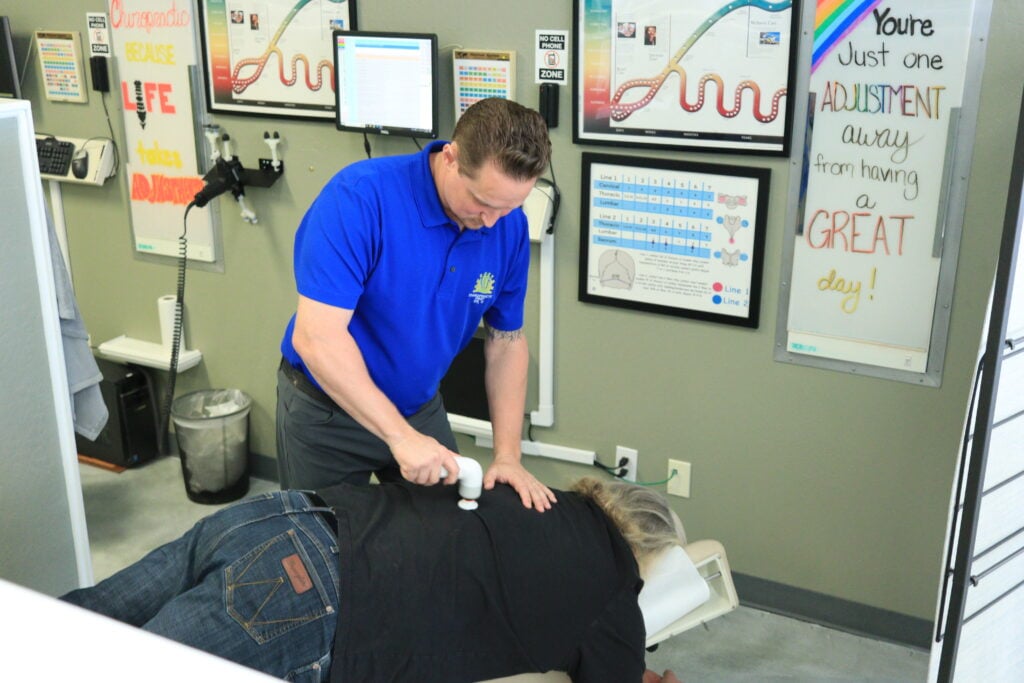
The treatment of choice for soft tissue injuries, the most effective care, is chiropractic .  As a patient, you have an absolute right to select the best type of care.  The right choice is to seek treatment from a doctor of chiropractic.  This is my first and most important recommendation.

Financing Your Treatment
The first question facing you is how to finance your treatment.  If you have been injured in an automobile accident, the answer is:  through medical payments coverage from an automobile insurance policy. “Med Pay,” as this type of coverage is often called, has two main advantages.  It pays the medical bills as soon as they are submitted by your doctor, and it pays them without regard to who was responsible for causing the accident. With med pay, you can get the treatment you need and pay your medical bills as you go.  You do not have to wait for a determination of how the accident happened.  And you avoid the risk of having to pay the bills yourself if the outcome of you personal injury claim should be unfavorable.  As long as the treatment is reasonable and necessary, med pay will pay your bills, promptly. Med pay is extremely important to your recovery. A patient with soft tissue injuries may require diagnostic procedures such as a CAT scan, or MRI, or a consultation with a specialist such as a neurologist or orthopedist.  These procedures are expensive and usually require immediate payment, med pay is often the only way to make sure that you can receive the treatment you need.

The second and equally important recommendation to pay for your chiropractic and other treatment after an automobile accident- use your med pay.

Where Do I Find Med Pay?
To use med pay, you must first find it.  Most people do not know whether they have med pay coverage.  The only sure way to tell is to examine every policy of automobile insurance that may be involved. Start with your own policy.  Review the declarations page, and if there is any question, call your insurance agent. if your policy does not have med pay, do not give up.   You may still be covered through someone else's automobile policy.

If you were driving someone else's car, look also at the policy of the registered owner.  If you were a passenger, look also at the policy of the driver.  You may also be covered by the automobile policy of a relative in whose household you are a permanent resident, even if you physically reside somewhere else.  Finally, remember that med pay is not limited to injuries sustained in a car.  For example, even if you are struck by a car while crossing the street, you are covered. “But,” you may ask, “isn't it unfair to have my medical bills paid by the insurance of someone who did not cause the accident?  Shouldn't the insurance of the person who caused the accident be the one to pay?” The only correct and fair answer is that both insurance companies should pay. Your med pay insurance should pay because you paid the premiums.  The other insurance should pay because, as the injured party, you have the right to bring a lawsuit against the person whose negligence caused the accident.  If you are successful, the court will award you a judgment ordering the wrongdoer to pay your damages.

Settlement
When the wrongdoer's insurance company anticipates a judgment against them, they will attempt to negotiate a settlement with you.  Should you settle the case early and then use the proceeds to finance your treatment?  T he answer is absolutely not. You should not look for payment by the wrongdoer's insurance company until you treatment is completed. Remember, a settlement is final!  When you accept a settlement you must sign a release of all future claims you may have that are related to your accident.  If, after a settlement, your injury turns out to be worse than you expected, you cannot reopen your claim.  The time to begin settlement negotiations is only after your treatment is completed. “But,” you may ask, “If I submit a claim for med pay, wont' my insurance premiums be raised?”  To answer this, it will not help to ask your insurance agent or the claims adjuster.  Their responsibility is to sell policies and discourage or otherwise dispose of claims; they have nothing to do with setting or raising rates.  This job belongs to the people in your insurance company's underwriting department.  These are the ones to ask. There is one important difference between what you can receive through med pay and what you can receive through a settlement from the wrongdoer's insurance company.  Med pay covers your medical bills, and nothing else.  A settlement compensates you for all of your damages.  In addition to medical bills, it includes loss of earnings, property damage, and the most valuable aspect of a personal injury claim: your pain and suffering.

Importance of Medical Records
In order to be compensated you must prove your damages, and for this, the most effective proof lies in your medical record.  It establishes your medical expenses, the nature and extent of your injuries, the type and duration of the treatment required, and any disability from work.  Your medical record helps to prove your loss of earnings, and it is the foundation of your claim for pain and suffering. This cannot be emphasized enough:  your personal injury claim is only as good as your medical record. To build a strong record, it is vital that you cooperate fully with your treating doctor.  Follow to the letter your doctors prescribed course of treatment.  Avoid delays in seeking care and gaps in the course of treatment: and do not consult with other doctors without a proper referral form your own doctor.

Related Problems as a Result of Your Accident
In order to support your claim for loss of wages, you should inform your doctor of all your work-related problems so they are properly entered into your medical record.  This will enable your doctor to document the duration of your disability and the extent of your restrictions and limitations on work activities, both during and after your recovery. To enable your doctor to document your pain and suffering, you must also tell your doctor, without reservation, all the problems and difficulties you are experiencing.  These may include much more that the pain and discomfort directly caused by your injuries.  You may also suffer secondary complaints such as dizziness, loss of equilibrium, recurrent headaches, loss of memory, or inability to concentrate.
At home, your usual family routine may be disrupted.  Ordinary daily tasks, such as housecleaning, buying groceries, doing the laundry, making repairs, gardening, picking up your children, may become difficult or impossible. At work, you may find that because of your medical leave or disability restrictions your performance and productivity are lower; raises or promotions have been lost or postponed, or your seniority or job security have been jeopardized. All of these problems can be alleviated with treatment, and compensated by law.  To resolve your personal injury claim successfully, you must both recover your health and win compensation for your damages. To achieve both of these aims I suggest that you choose chiropractic treatment and use your med pay.

My final recommendation is this:  retain an attorney who is experienced in personal injury and who understands and approves of chiropractic. With your full commitment and cooperation, you and your doctor will be able to speed-up and maximize the recovery of your health.  Working together, you will build a strong medical record that contains the full details of all your damages. Armed with such a record, your doctor will also be able to provide your attorney with a final narrative report that is well supported and convincingly documented. You, your doctor and your attorney must work as a team.  This is essential if your attorney is to win a settlement for you that is both prompt and fair.